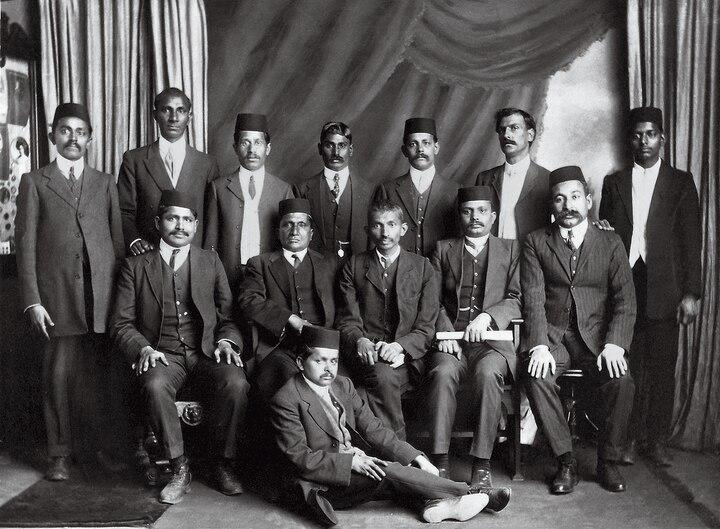
Gandhi is pictured with associates in Natal in the early 1900s.
2026-03-23 937词 中等

In South Africa, Gandhi developed his theory and practice of nonviolent resistance. His study of Christianity and Islam also confirmed a lifelong belief in the necessity of peaceful coexistence among religions. Upon returning to India in 1915, Gandhi’s initial support of the British during World War I shifted to an increasingly critical stance. The 1919 Rowlatt Act, which allowed British authorities to imprison suspects without trial prompted Gandhi to organize a campaign of satyagraha. Although the call to peaceful activism was widely heeded, violent outbreaks did occur. British soldiers opened fire on unarmed protestors at Jallianwala Bagh in Punjab in April 1919, killing several hundred people. Gandhi was jailed for sedition in 1922, and by his release in 1924 was the most famous man in India. In 1930, he launched another satyagraha campaign against the British government’s new law to limit the Indian production and sale of salt, an important staple. Gandhi led the 240-mile Salt March in late March and early April of that year, destined for the coastal village of Dandi, where he collected salt in open violation of the law. By combining nonviolence with spectacle, and uniting Indians across caste and religion, Gandhi sealed his reputation as not only India’s leader but also a global icon of resistance.
免责声明:本文来自网络公开资料,仅供学习交流,其观点和倾向不代表本站立场。